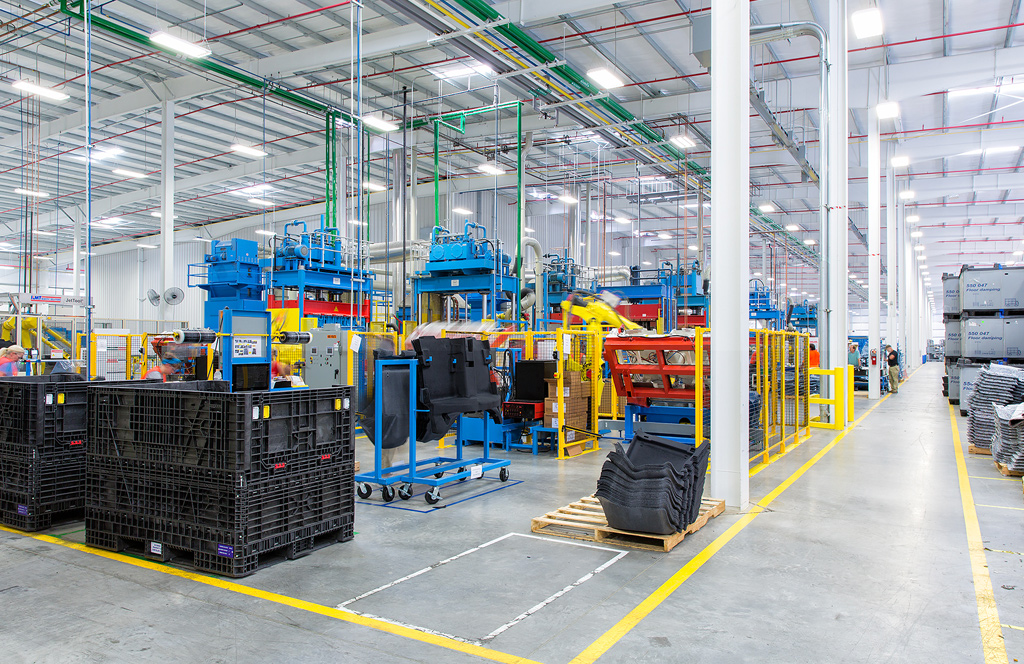
Adler Pelzer Automotive Slovakia is a manufacturing company based in Bratislava (Devínska Nová Ves), which belongs to the international Adler Pelzer Group. The company operates in the automotive industry and focuses mainly on the production of interior and acoustic parts for cars.
The company supplies components to car manufacturers, such as the Volkswagen Group, mainly parts that improve vehicle comfort and noise insulation.
It has been operating in Slovakia since 1995 (originally under the name HP Pelzer Slovakia) and is among the suppliers in the automotive sector with dozens to hundreds of employees.
What led Adler to deploy a new information system?
- Absence of asset management and maintenance software.
- A large part of the processes operated in spreadsheet forms.
- Paper records of some services.
- Difficult record keeping and processing of documents.
- Lack of clear reports and analytical overviews.
- Lack of the ability to work from the machine – there was no mobile application.
How was the implementation?
The initial idea for digitalizing maintenance arose in 2022. In the first half of 2023, cooperation began with a series of business-technical meetings, during which the project framework and its expected outputs were defined. In the summer months, the project moved into an active implementation phase. Already during the initial online meetings, a basic solution proposal began to emerge, which later became the pillar of the entire implementation.
The entire process was divided into several steps. The biggest technical and organizational challenge for both teams was the implementation of the project exclusively in an online environment, without physical meetings. During the online meetings, the current state of maintenance management was described in detail, weak points of the process were identified, and all the documents necessary for successful implementation were presented. The analysis also included ongoing discussions on the system configuration options, which enabled the gradual co-creation of the future solution.
Based on the analytical outputs, a comprehensive system concept was created that connects individual types of maintenance, asset management, form registration and warehouse management. The first step of the implementation was the import of the object structure, sorting and categorization of equipment. Subsequently, processes were created for operational maintenance, preventive maintenance and for the collection of technical and operational data.
The specific output of the analysis was a solution proposal for entering mold changes and transfers between warehouses. This module is intended mainly for production planners to enter mold changes on machines and the subsequent performance of setters and toolmakers. The advantage of the module is an accurate overview of future mold changes, the real location of molds in production, the time of changes, the costs of changes and history.
One of the last parts of the implementation was setting up warehouse management, including defining inventory items, warehouses, and bins.
As the system gradually took shape, its first functional form began to emerge. Joint testing on both sides enabled fine-tuning of processes, control of data flows, and adjustment of details so that the solution most accurately reflected the customer’s real needs.
After successful testing, the system was deployed into production. Internal user training was conducted to ensure a smooth transition to the new digital form of maintenance management.
As business processes naturally evolve, so do the Hexagon EAM and iWi systems that support them. There are more and more tasks and processes performed in the system that the customer could not even imagine before implementation. With the growing volume of data, more extensive analytics were created, new dashboards, reports and functionalities were added.
The result of the implementation is a flexible solution that not only supports current processes, but also creates a solid foundation for their further modernization and digitalization.
What are the main benefits of deploying a maintenance information system?
Paperless and modern maintenance – all information is recorded electronically, without the need for manual transcription from paper sheets. The risk of errors is eliminated, data accuracy is increased, and time and operating costs are saved.
Accelerated information flow – data is immediately available to maintenance and management personnel, enabling rapid response, transparency, and effective decision-making. Digitalized procedures have eliminated manual operations, reduced response times, and accelerated the entire fault resolution process.
Standardized maintenance process – all activities are carried out according to uniform rules and methodologies. The established standardization contributes to higher quality of work, simplifies planning, improves process oversight and ensures their uniform implementation across the entire organization.
Advanced reports and clear dashboards – management gets an immediate overview of maintenance performance, equipment status, intervention effectiveness, and planning. Visualized data facilitates strategic decision-making and allows identifying opportunities for further optimization.
Functionalities supporting further digital development – the new system is built on modern technologies and an open architecture, making it ready for future expansions with additional modules, automations or integrations. It represents a stable foundation for the long-term process of digital transformation of maintenance.
A single central point for maintenance – all requests, fault reports, work performance, documentation and management reports are concentrated in one place. Requesters have a clearly defined reporting channel, maintenance workers work in a unified system and management has a comprehensive overview of the maintenance status across the entire organization.

Ondrej Meliš
Maintenance Manager
Customers are increasingly demanding from us the modernization of maintenance management with an emphasis on efficiency, transparency and availability of data in real time. That is why we decided to implement a CMMS solution from Inseko, specifically the iWi platform in combination with Hexagon solutions. The choice was based on their professional approach, ability to deliver a turnkey solution and quick integration into existing processes. The result is a transition to paperless maintenance, which provides us with accurate data on downtime, maintenance costs and a complete history of interventions. The implementation also includes effective planning of tool changes on production lines, which significantly contributes to the optimization of operations and the reduction of unplanned downtime.